Monday, January 16, 2006

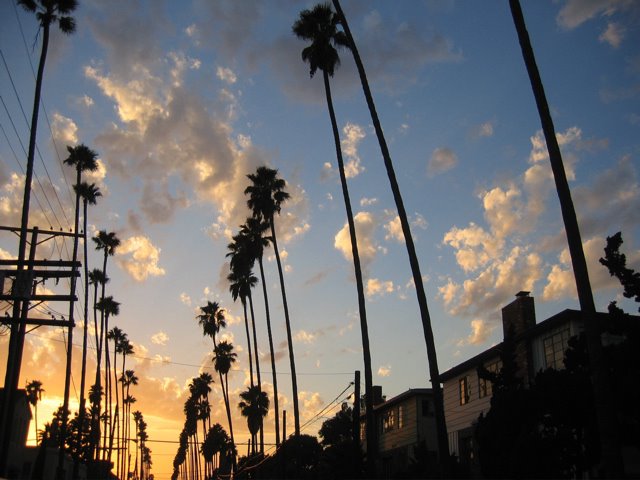
Sunset


A pretty picture of L.A. that got tired of hiding deep inside my hard drive.

In Media News (how very blogger-like of me!) ... The MIT Technology Review has responded to current publishing realities by cutting back from 12 to six issues per year, devoting more resources to its website, and changing the editorial focus of each product. Details of the changes are provided in a letter cello-wrapped with the latest issue, which features a cover story by former Salon editorial nabob David Talbot entitled "The Internet Is Broken: It's Time to Replace It." This is the first time (I can think of) that a magazine has adapted in this way, and so proactively. Don't they usually just ride the printing press into the ground? Those MIT folks don't miss a trick.

*

The Biggest Vanilla Shake

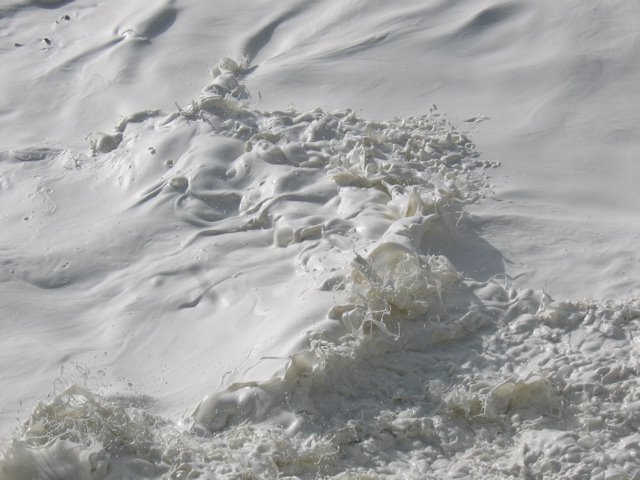
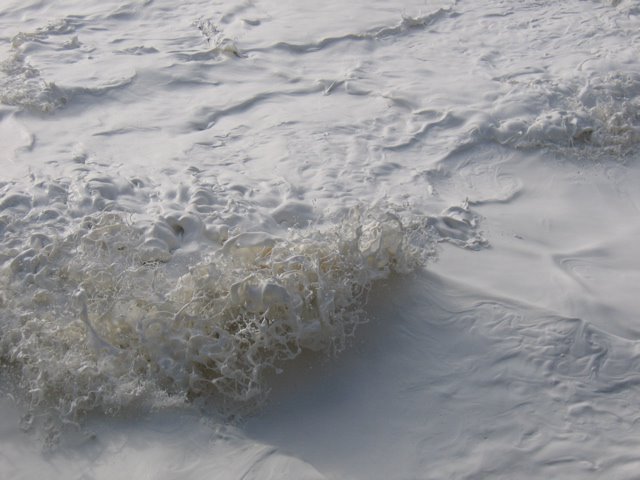
Gosh, blogging again. Maybe the readers will come back. Here's something I wanted to show you. Yes, you. Up in Northern California just before New Year's Eve, when that big headline-snatching storm was soaking and swamping everything, the sun emerged a few times to illuminate the havoc. And here's what the surf looked like, tossed so thick with foot-deep foam it seemed to move in slow motion. Waves of pure bubbles crashed on the rocks and sand, spewing up globes of emulsion that exploded into smaller globes and then arcs of gleaming filmy nothing. It was hypnotizing.

I did what I could with a sluggish digital camera to capture the wonder of the extra jumbo milkshake.


And more of the same.


*

Things Are in the Saddle ...

... and ride mankind." Attributed to Emerson, quoted to me last week by a dealer of antiques and objets d'art. And swimming to the surface of my pond daily as I strive to consolidate and compact the detritus of my once-well-stocked home. Now that I am a vagabond, I occasionally wish I could more easily lose my possessions. Socks forgotten under the motel bed? Kid stuff. I'm looking for jackets, books, whole collections of stuff to disappear. Nothing like lugging a 50-pound suitcase from one airport to another to make a lugger wish for less luggage.

Chairs, lamps, speakers, shirts, books, dishes, CDs, and stacks and stacks and stacks of papers, all flung up onto the blazing sands ... life looks very different without a basement. Or a closet. Or a cupboard. I liquidated so much stuff in December -- I keep seeing my former things in friends' houses -- that it feels like some kind of cruel reflux that keeps me wallowing in more of it. Like the plumbing is broken and the house keeps flooding. But I'll be gone very soon, living out of two suitcases for a while, and then I'll start wondering again where specific things went. A friend of mine who's been roadbound for two years says he's reduced his trove to a few boxes of writings. But he was never much for things. I suspect it's harder to be sentimental when you have no things to remind you of what was.

Today I went to pick up a few boxes stored in a friend's garage. But when I found only one of the four boxes, I could barely muster a scrum of anger. Even slight disappointment barely held its own against a warm spreading relief. Just. Didn't. Care. Sure, I went through the motions, calling, asking, mostly because I'd promised the two boxes of ancient MAD magazines to the son of a friend of a friend, but I barely cared. Less to handle, less to store, less to repack. What's to miss? Who needs it? Eventually, someone called back and told me about the secret other room, where the rest of my things were waiting, so I had to go back and cart everything off. The kid will be happy, jeepers, but now I have to figure out what to do with a tennis-themed wall sculpture by Jere, a T-square, a tube of once-beloved posters, a stack of crumbling '60s design magazines, and some really great light fixtures I never want to see again if cash isn't involved. So who's riding the cart, and who's in the saddle? Who cares? All I know is that my feet are tired.

*

Saturday, January 14, 2006

The Dogs of Yore

A LordZim return to form, compromised by an uncharacteristic weight of personal detail. Call the cops!

Last night I met S at her house for dinner. I'd been stuck inside working for days and was looking forward to a long walk beforehand with S and her dog, preferably in the hills, like the walks I used to take with my dogs. Back when I had dogs.

The hills proved impractical, so she suggested we simply walk the dog to the restaurant. Fine. Good idea. But R the dog had been acting a little loopy for the past few days, so we'd have to see if she could handle a walk of that duration. Fine again. In the last year of my dog Cheyenne's life I grew accustomed to ending walks almost as soon as they'd started, thanks to his arthritis. You can't simply walk a dog through the discomfort. You'll only make it worse. Because they want to follow and please you, most dogs will overextend themselves as long as you're leading. Being alpha dog has its responsibilities, and one of those is to ensure that your adoring pack of one doesn't self-destruct on your behalf. So when R started limping just three blocks from home, we turned around and took her back.

S is a pretty stoic character, but watching her companion of 13 years start to slip, literally, cut through her veneer and tapped into a terrifying helplessness that's probably universal among the loved ones of the gravely or just mysteriously ill. I remember the feelings well ... or as well as my titanium repression lets me. After both my dogs died in 2004, I allowed -- maybe willed -- my subconscious to entomb those memories as quickly as possible. Those who witnessed my months of perma-mope might say it didn't really happen all that fast. It's a free country. Say what you want.

Now, like the buried Cheonggyecheon river newly unearthed in the heart of Seoul, my memories are resurfacing, thanks not to therapy or Rolfing but to a coincidental generational shift among my friends' dogs. Or maybe it's all coincidence, and I'm just creating the continuity I crave in my constantly changing circumstances.

Alliteration is such a cheap trick. I hate it when I do that.

Back to the dog. That very much alive dog, straining at the end of her leash as if miserable at the captivity. Or perhaps glad to have something to lean on. She seemed to be having a hard time balancing, and had in fact fallen over earlier in the day. She walked back home very slowly, sniffing everything ostentatiously until we reached the comfort of her living room, where she greeted a biscuit with pronounced apathy. S watched, concerned, as I made a big fuss over the biscuit, teasing R with it until it seemed worthy of her attention. When I finally tossed it across the room, the dog followed, claws skittering madly on the newly slippery wood floor. She stopped over it, picked it up gingerly with uncertain teeth, and then repaired to the couch to dismantle it. Seeing her thus occupied, we left again.

Masked Intruder

It was a 20-minute walk to Café M de Chaya, but we probably stretched it out by skirting the boulevards for the placid residential streets of Hancock Park. We were crossing Wilcox or Cole when a pale, high-backed creature caught my eye as it galumphed across the street. S thought it was a coyote, but I've seen enough coyotes -- tall, lean doglike creatures -- to know them from pretty much any other nocturnal quadrupeds. I thought it might be a possum, but possums do more creeping than galumphing, so I opined that it might have been a raccoon. We halted and headed back to see what we could see. Yes, it was a raccoon. S was immediately satisfied and, fearing rabies, ready to go. I, fearless, foolish, wanted to watch that masked critter and see what it was up to. It looked up at us from across the lawn, then turned and slipped through the iron bars of a driveway gate and trotted off toward the garage. A moment later, another pale creature darted furtively out via the same gate, then stopped to lick its feet. The cat. The pussy. Maybe it was afraid of rabies too. It noticed us watching and leapt lightly onto a windowsill, as if to pass the next few minutes above the fray. We resumed our walk to dinner.

Food Interlude

S later said, in her amusingly sweeping way, that M Café was the first restaurant she'd ever seen me not complain about. While I object to the slanderous implication that I complain all the time or even frequently -- I cheerfully wolfed down everything at Amala Dhaba in Westwood tonight -- I will agree that MCDC may as well have been designed with me in mind. It serves high-end macrobiotic food, the kind you'd have to slog through a year or more of soul-numbing rice-beans-seaweed detox before a proper macro regimen would ever allow. If Café M has a flaw, it's the desirable curse of variety. I wanted to try everything. I settled happily on a pre-assembled bento box containing a dozen different items, all of which proved to be at least interesting. If I were staying in LA I'd probably go there often.

We walked back from dinner and found R the dog sitting on the couch. She didn't jump off to greet us, but wagged her tail and panted and drooled and even shook a little as I gave her a full rubdown. After ten minutes she still hadn't stopped panting, and when a concerned S invited her to walk across the room, she slid off the couch and fell over and then stood up again panting and shaking violently. That's when I saw the panic crease S's face. It looked like her dog was having a stroke. Neither of my dogs had ever exhibited those symptoms, so I had no practical advice to offer beyond yes, you should go to the emergency vet.

It was 10 and I had work to go back to, but I vividly remember the isolation of sitting with a stricken dog in a vet's exam room listening to the life and death options at one's disposal. It's a lousy place to be alone. And given R's passing resemblance to my dog Cosmos (we're all labs on this bus), I seemed to be experiencing a weird transference. I followed them to the all-night vet in my own car, telling myself more than once that it was not actually my dog in question.

It was the same all-night vet clinic that had done such a bad job of sewing up Cosmos the night she was attacked by a pit bull in Alta Dena 10 years ago. Not that I hold a grudge. They'd spruced the place up a lot since then -- stone-faced counters and plasma TVs -- but when they laid the hard sell on us about how much the dog needed to stay the night, we could see it was still just a clip joint. The Jeff Spiccoli lookalike vet's provisional diagnosis was that R is suffering from a vestibular condition, comparable to a human inner-ear disorder that leaves one dizzy and nauseated. It's common among older dogs. I'll spare the details, but after Spiccoli admitted that none of what he was recommending was essential, a stern lab tech/closer came in and terrorized us with innuendoes and warnings. Tried to, anyway. He seemed to be working on commission. We left with the dog, skipping $400 worth of overnight monitoring and tests.

In the morning, S took R to her regular vet, who echoed Spiccoli's prediction that R the dog will probably be better within two weeks. What has S so upset is that in 13 years she's never seen her dog in anything less than perfect health. Hybrid vigor. Luck. Lucky them. I used to wonder whether I dared wish that my dogs would die instantly under the wheels of a car. They didn't. They both endured long, traumatic, debilitating diseases.

When I moved last month, I finally tossed the overstuffed files containing all the vet receipts for my two dogs. Once upon a time, before they died, I'd thought that maybe one day I'd add them all up -- just for fun? --- but what the hell would be the point of that? To prove that I spent a fortune on my dogs? To relive all the bad times? Give me one good reason. Or don't bother. I tossed them all. Maybe they're fruit juice labels by now.

And synchronicity keeps on rolling. Today at home (or what passes for it this week), I flipped over a holiday card from an old friend, a card I'd somehow neglected to read when it showed up a few days ago. E and I had met 14 years ago at the illegal Tar Pits dog park because our dogs, puppies then, had played so well together. We became friends and though I eventually moved away and the conjugal dog visits grew rarer, we stayed in touch. Sort of. Kids change everything. His dog, Brian, had always been a friendly, goofy tank of a lab mix. He used to leap up and strip the fruit off the lower branches of the persimmon tree every year. He taught Cosmos to eat persimmons too. Brian had slowed down in recent years but was amazingly fit the last time I saw him. Was that two years ago? He'd outlived Cosmos, his estranged playmate. Last year I'd been on my way to visit E and co. in their temporary Sacramento home when a political discussion his wife and I had via cell phone drove me away. Wish I'd stuck with the plan. In his 2005 holiday card, E wrote, "Brian died last month. He was a happy sweet dog till the end."

I guess I knew Brian wouldn't live forever, but when you don't see the eyes clouding over and the limp deepening, it's easy to deny time. Seeing R in her extremity last night affected me so deeply because her infirmities took me right back to my own dog stories.

All dogs have their own stories, and some live to be 18 or beyond. The average dog lives to be about 12. Smaller ones last longer, and jumbo editions like Great Danes usually expire around eight. A few years ago, someone told me he'd heard an 80-year-old man say, "Dogs are fine, but they don't last very long." I think about that perspective a lot around older dogs.

I started this post to describe how well the raccoon had trained the cat.

*

Wednesday, December 28, 2005

AZ Lexico Part 3

Back again, not by popular demand but by my pop's own linguistic hand, one of LordZim's most beloved features .... the AZ Lexico! Wherein we document and pay tribute to my father's innovative approach to English.

Today's entry:

Snobbing: to snub in a snobbish way; e.g., "She's snobbing us."

Sometimes, the rules not only don't apply, they don't make as much sense as the violations do. Three cheers for the AZ Lexico!

*

Saturday, December 17, 2005

See Changes

Since the last post, I have sold or given away about half of my worldly goods, thrown a giant farewell party for myself and my house, moved out of that house, and driven a third of the way across these United States. Lordy Zim, Lordy Zim, where have you been? I've been to Las Vegas, to take in the scene conjured up by my esteemed former neighbor and great talent Johnny Coppola, who brought his latter-day rat pack stylings to the Riviera for two nights.

I hadn't been to Sin City in 15 or more years. Everything seemed so alien. Wandering through a dozen or so casinos I observed that in the low-rent venues, a thin layer of pop music floats above the bleeps and chirps of thousands of slots and other fund-removal devices, laying a cheesy veneer atop the entire desperate gestalt. In higher-end casinos, however, an invigorating sonic tapestry underlays all the other noise. It lacks melody and percussion, beginning and end, but it envelopes all the bleeps and bloops into a comprehensive New Age-y soundscape of endless hope and irresolution. Brian Eno wrote "Music for Airports" to calm travelers for the possibility of death, so "Ambient Music 7: Music for Casinos" readies gamblers for the likelihood of total loss. It makes the world seem manageable and fun, full of hope and promise, even as cherries line up with pears and bananas into a fruitless salad.

That's what I thought when we first walked through the Paris. I was convinced that the music was a highly refined psychological tool invented in labs and perfected in focus groups. But today, when I heard virtually the same sounds at Mandalay Bay, I listened more carefully and decided that there is no music programming -- that the complicated, sophisticated sound is just the cumulative effect of millions of bleeps and bloops, all somehow bleeping and blooping in key, like an exponential expansion on windchimes. And someone recognized that a pop soundtrack doesn't really add anything to the experience.

Of course, I'm probably wrong.

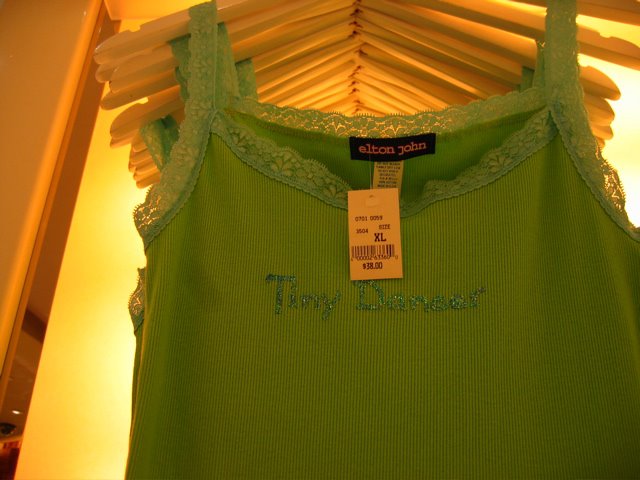
Speaking of pop music in Las Vegas, both Elton John and Celine Dion have their own retail outlets in the hotel where they perform. The very young woman behind the counter of Mr. John's store said that no, she's never seen him in the store and they do not sell toupees, but yes, they do sell sunglasses, and many people do ask why such a wide variety of items proclaim "The Bitch Is Back." Folks just don't remember that 1974 song. By contrast, Ms. Dion's store looked like a cosmetics counter.

And here's a funny little snapshot that sums it all up:


*

Wednesday, December 07, 2005

Hoovesdropping

Lord Zim is lazy. Lord Zim is busy. Unbearably busy. Ok, maybe not so very lazy, but in any case, Lord Zim the wastrel is too busy to do LordZim the blog justice. And therefore, inspired by the following scrap of silliness filched from the dim, dank recesses of an external hard drive, LZ presents for your reading pleasure a semi-meditation upon Hollywood horses. And what the torrential rains of last Spring might have made them think and do. It's LordZim before LordZim existed, resurrected to tear holes in the fabric of time. And to give you, the clamoring public, something to read.

(OK, yes, I'm recycling. It's not new, but it's new to you, and right now, closing in on a month of silence, that's what counts. Plus, it's not too far off from donkey issues, which, along with NYC Discos (see way below), seem to be LZ's main claim to fame. Or should I say mane claim to -- no, I shouldn't.)

Horses
March 1, 2005

We'd had two weeks of pretty steady rain here in sunny Southern California, and I thought I'd take a break from worrying about my house sliding down the hill. If you consistently worry about just one thing, your worrying loses structure and tensile strength, so it's good to cross-worry. I didn't have far to look for the object of my next set of concerns: the horses of Hollywood-Sunset Stables.

If you've ever had to entertain tourists, if you've ever walked up to the Hollywood Sign, or if you've ever had to put together a birthday party for a 12-year-old girl, you know about the Stables. Perched at the top of Beachwood Canyon Drive, nestled just below the Hollywood Sign (yes, that Hollywood Sign), the Stable is so busy perching and nestling, it's a wonder it has time to represent a bucolic outpost of cowboy culture mere steps from movie stars' mansions.

The stables exist for the recreational exploitation of horses, yes, but they're home also to goats, chickens, and a few scrappy but affectionate herd dogs. Each weekend, and to a lesser extent on other days, would-be buckaroos from around the world make their way sheepishly up to the mounting porch. That structure is less the amorous hideaway its name might suggest and more of a diving board/training wheel for equine beginners. There, from its worn planks, tenderfooted tourists sling themselves onto the backs of docile quarter-horses and set out on the well-trod paths of Griffith Park.

I once exploited just such a horse for my own purposes as part of a "twilight ride." The expedition, if such a high-flown word may be applied to so mild an entertainment, consisted of riding a horse slowly up one side of the Hollywood Hills, past an enormous landfill or strip mine, and then down the other side of the hills, through the mysterious dusky reaches of Griffith Park, under the 134 Freeway, and finally to a Mexican restaurant at the dusty mouth of the Burbank Equestrian center. All this I performed in the company of 9 to 29 of my closest pals.

At Viva Fresh, we hitched our horses to a long rail and entered the joint en bowlegged masse. We lined a long wooden table like Knights of Olde and set to work quaffing bottomless pitchers of margaritas, cramming endless crackling chips into our mouths, and shoveling in landslides of melted cheese. Hours of fun later, we finally staggered back to our patient steeds. They knew what to do. Though most of us had a job of it just staying awake and erect in the saddle, the horses, like genial old butlers, stumped along nose to tail in the lowering gloom all the way back to their stable.

Through the haze and dusk we rode, under vales of oaks, past fallen pines. A trio of owls atop a rotting log regarded us solemnly as we passed.

The rest is a blur to me now. We slid off and relinquished our horses to contemptuous stablehands, patted our butlers' noses good night, and let others lead them away.

And so it goes for those horses. Day after day, they make their way through the hills bearing fleshy cargoes, until the day they can no longer crest the steep initial ramp out of the stable, and then … and then … who knows where the butterfly goes when it rains? The glue factory? The French slaughterhouse? The strip-mine landfill?

So back to my point. I'd been wondering how the horses were faring amid all this rain. Had they grown stir-crazy? I called the stables. (This is true.) "What's stir-crazy?" asked the answerer. Then he declared, "They're doing fine." He was not entirely convincing, though he said a few intrepid souls had gone out for a trot the previous day, one of the wettest ones yet.

I didn't believe a word of it. So I committed to a little equine sleuthing. Hoovesdropping. It was a dark and cloudy night, aand there I was, creeping behind the barn. A goat baaed derisively as I slunk by. Presently, just outside the main building, I heard the following.

"I don't mind the wet, but I sure do miss the sun. Nothing makes my chestnut flanks gleam their rich golden hue like a good dose of sunshine."

"Sugar, what I miss is my mane. I used to have the flossiest, most delicious neck of hair, and now it's all gone straight to frizz. I just wish I could get my forefeet on a bottle of Flat-Out."

"Nay, nay, nay. You mares are all alike. The mud all up in my shoes is driving me crazy. I don't know if it's the cut-rate farrier or the tipsy stablehands. I say, either let us run around barefoot, or pick out the crud on a regular basis. I'm not asking so much. But the indignity of wearing --"

"Oh, hush up, you old gelding. I'm just surprised you haven't trampled anyone lately, what with your moods and all."

Silence. The swish of tails and an occasional snort.

"Not many flies these days though."

"Amen!"

"Got that right!"

"Thank heaven for small favors!"

More silence. The goat baaed again.

"Jimmy, please don't start."

"Come on, Jimmy. Go back to sleep!"

"Goats should be seen, not heard."

"Hey, lay off the little guy."

"Hey, who cut the chevre?"

The barn exploded with something like a chorus of laughter and neighs. The goat let out a small cry of frustration and skipped off into the paddock. The laughter faded to silence, and then the voice that had earlier complained about frizz interjected.

"You horses are just mean. Now he won't come back in here for days. Who's going to rub my shins? Hm? Exactly. None of you. Just mean."

One of the others started to neigh something, but a set of hooves banged against the wall and shut him up.

After that, nothing broke the silence but the steady chewing of massive equine jaws. Presently:

"Wish the rain would stop."

"Why? So you can get fat tourists climbing all over you again? Sitting too far forward, pulling on your mane, bouncing wrong, and calling you 'Doggy'? None for me, thanks. I like this rain just fine."

"Mmm-hmm."

"Amen to that."

"Tell it, Clarabel."


And that's all I wrote. If you're interested in a subsequent installment, email me or comment below.

For more scribbling on equine topics, see the links at left and visit the donkeys.

(En als je kan dat lezen en je K bent, ik heb je email verloren. Schrijf me iets, alsjeblieft. Veel bedankt. Sorry, hoor, voor het verschrikkelijk fouten.)

*
Friday, November 11, 2005

How I Became an Ass Man

All my donkeyblogging has paid off. Well, sort of. Lucy Fensom, founder of Safe Haven for Donkeys in the Holyland, liked my three posts so much that she asked me to write about my experiences for SHADH's printed newsletter. Given the specific readership that publication must enjoy, I thought I'd expose this little tale to the even more specific Lord Zim audience first. Cross-platform, inter-continental, self-aggrandizing, late-night log-rolling. Glad to be of service.

Five or six years ago, when I first read about SHADH in the Los Angeles Times, I made a vague resolution to look up the Englishwoman who was flouting Israeli custom by rescuing donkeys. Time passed. More time passed. I was here, they were there. I might as well have forgotten about it. Little did I think that one day I'd be besotted with these same donkeys and unable to stop thinking or writing about them.

But how did this happen? In July 2005, I went to Israel for two months to write about the Gaza disengagement. I wrote one long account and planned to continue, but after Hurricane Katrina swept Gaza off the media map, I turned my sights elsewhere.

Committed animal lover though I am, I had never given the noble ass much thought. Alas, few do. After five visits to SHADH, what I see now is that they simply don't get good press. If folks realized that a happy donkey is as friendly and playful as a dog, these horse-shaped, rabbit-like creatures would be as popular as baby seals and as beloved as Great Danes, whom they resemble in temperament. Call me crazy, but I think it's all in the presentation. Of course, I do live in Hollywood, so perhaps my view of the world is warped. OK, definitely warped. But Lucy and all the volunteers at SHADH would agree with me: To know donkeys is to love them.

The first ones I met, however, were too tired and broken to show any spirit. These were the poor creatures who showed up at the Tayibeh clinic, where Lucy, Adi, Pierre the vet, and a few others tendered first aid and vitamins, bridle and hoof care, and fresh hay and water to all four-footed comers.

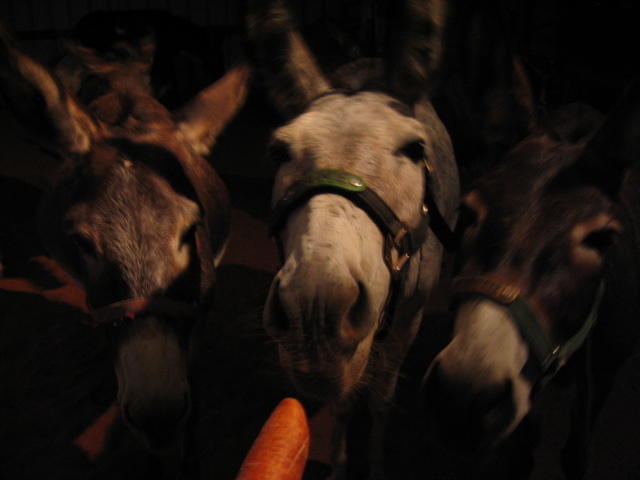
After three exhausting hours in the field that day, we went back to the facility at Gan Yoshiya, where nearly 100 donkeys have regular access to such tender mercies. There I saw beasts of a different stripe altogether. I hand-fed these bold, comical creatures carrots for an hour or two, completely losing track of time. Some flocked, others fled. (Just like the people I meet.) I took hundreds of photos that evening in the low barn light, and only stopped when the dust kicked up by hundreds of impatient hooves got the best of me. I was out there for so long, Adi thought I'd turned into a carrot and been eaten. The following day, when I started rhapsodizing about donkeys, my relatives thought I'd gone crazy.

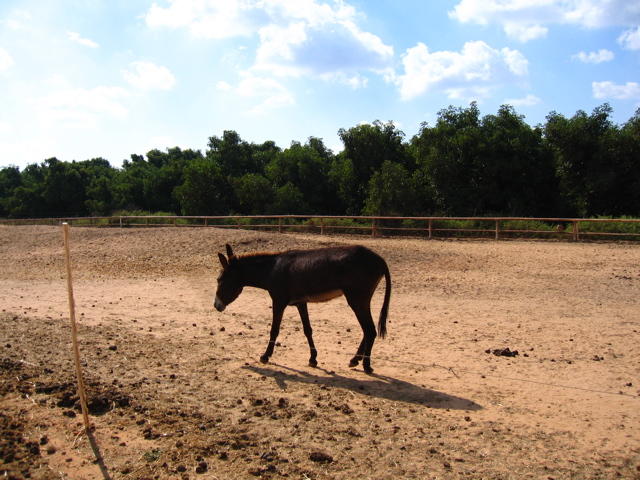
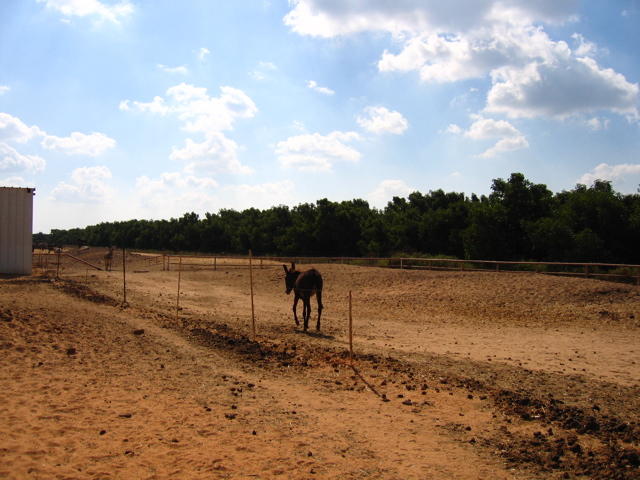
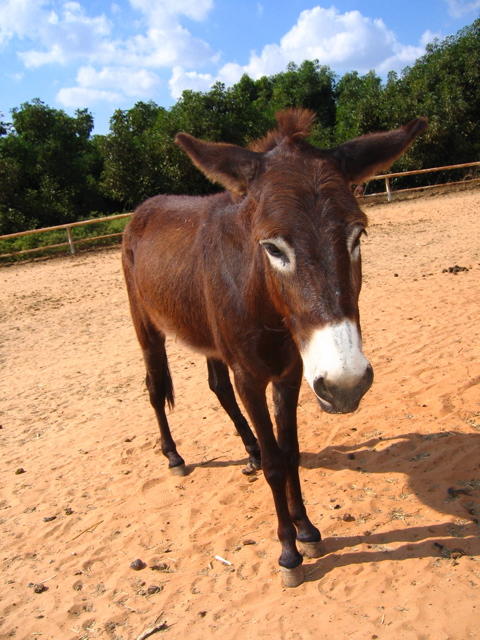
On my next visit, I climbed into the corral with the "Bad Boys." One of them, a small brown scamp who shall remain nameless (his bridle had fallen off), was chasing another the length of the paddock. Up and back they ran, up and back. It was hilarious, though perhaps less so for the one in front. Eventually they stopped, and I made friends with the miscreant, whose aristocratic profile to this day adorns my computer desktop. I'll never forget the moment I realized that when he held my sleeve in his teeth he wasn't trying to bite me; he was just making sure I wouldn't go away.

There were other high points: playing with two-month-old Moonbeam on my third visit, and then marveling at Petal's one-day-old foal on my last. There were mixed blessings too: seeing how many of SHADH's charges have become lame or disfigured through human cruelty, while taking heart in the fact that for all their suffering, they're living out their days in something like paradise. And then there was the unalloyed gloom of the violence done to the Tayibeh shelter, an appalling example of just how low people can sink when borne down by greed. I presume that event is amply addressed elsewhere in this newsletter, but you can read my account at my blog, Lord Zim.

And that is why you are reading this rambling account now. While struggling to find an angle on SHADH for a proper article in a real publication, I started writing freely about the place on my own blog. By the time I left Israel in October, I'd written three extended tributes to donkeys and SHADH, all of them liberally illustrated with my photos. If you'd like to read these efforts in order, just go to Lord Zim (http://lordzim.blogspot.com), and click on the "September" link at left to find the first post, "Donkeys!" (You'll have to scroll down.) Then you can go back to the main page to find the annotated photo essay "Behold the Heroic Donkey" and "The Dark Side of Donkey Rehab," which addresses the Tayibeh incident and the actual work of providing care for distressed animals.

I look forward to my next visit to Gan Yoshiya. Moonbeam will likely be full-grown, but perhaps Petal's daughter will still be coltish. I may be thousands of miles away now, but I think about donkeys every time I turn on my laptop — especially that feisty little brown one.


The Aristocratic Profile

*
Wednesday, November 09, 2005

More Car Hijinks

OK, this is getting weird. Two PaCarazzi sightings in two days. Is that the universe knocking? Read all about it at PaCarazzi!

*
Monday, November 07, 2005

Something New at ...

PaCarazzi!

That's right, America's favorite site about stars and cars comes roaring back from the dead (sea) with a classic tale of San Fernando Valley intrigue. Featuring a real live hot actress and an expensive SUV.

G'wan ... get your motor rollin'. Head out on the parking lot. Go read the latest from Pacarazzi!

*

Thursday, November 03, 2005

Cows Across the Waters


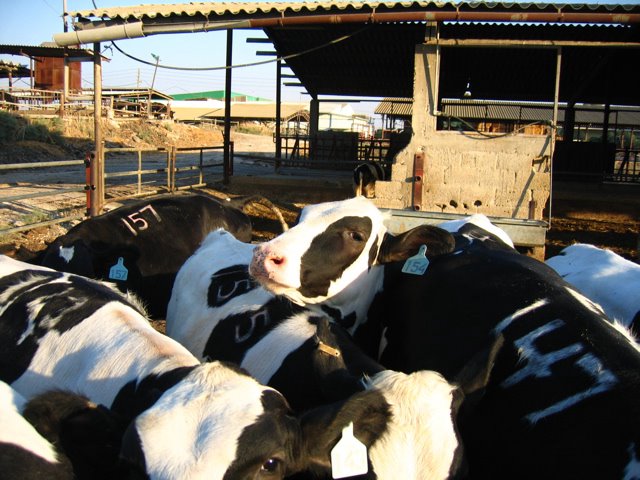
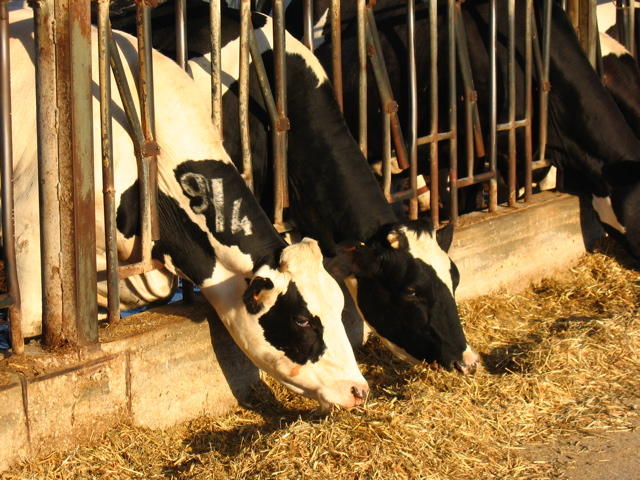
Last Sunday, I found myself in desolate Norwalk, CA, unlikely home to what may be L.A.'s last suburban dairy. Well over a hundred cows and dozens of very free-range chickens live in a vast mud field flanked by a mini-mall, an automotive salvage yard, and a very small, very old wooden house. Car parts, trailers, and assorted machines litter the property. It's hard to get answers at the Norwalk Dairy, but it looks like the final remnant of agriculture in a lower-middle-class suburb where property values never rose high enough to kick out the cows or keep out the junkyards.

Eight years ago, the flimsy shack out front was just a dairy outlet. When I stumbled on this place, way back when, I couldn't finish a half-pint of full-fat chocolate milk. It was thick as a shake, but without all those reassuring texturizers.

These days, the place is jammed with refrigerator cases full of soft drinks, shelves packed with snacks, and all the trappings of a scruffy convenience store. It took me a minute or two to locate the dairy's actual products -- unlabeled plastic half-gallons of the freshest milk for miles around, all lined up in a glass-fronted fridge behind the counter. You can't buy eggs from the local chickens though -- the dozens come from somewhere else.

For all the Lotto posters and celebrity magazines, it still smells like a dairy. A lot. It's a gloriously seedy surprise, simultaneously out of time, place, sight, and mind. Go visit the cows, and then, if you still have an appetite, stop at Renu Nakorn, the renowned Issan Thai restaurant just a few blocks west. You just might be in the mood for tofu.

Why Cows Are Mad


Adolescents: Not quite numb and numbered

Almost two months ago in Israel, I wrote a post about how agriculture turns cows, fish, and migrant workers into "robots," to use my farmer uncle's term. A new story on Haaretz.com, "More Milk Means More Udder Pain for Cows," addresses just how far off the rails Israeli dairy farmers have gone in their efforts to maximize milk production.
    "[C]owsheds have been transformed into an industry that causes suffering to all those involved in it: the cows, whose living conditions are dictated by factors of economic productivity; the Thai workers, who are usually employed in deplorable conditions; and the farm owners, hundreds of whom are on the verge of financial collapse."

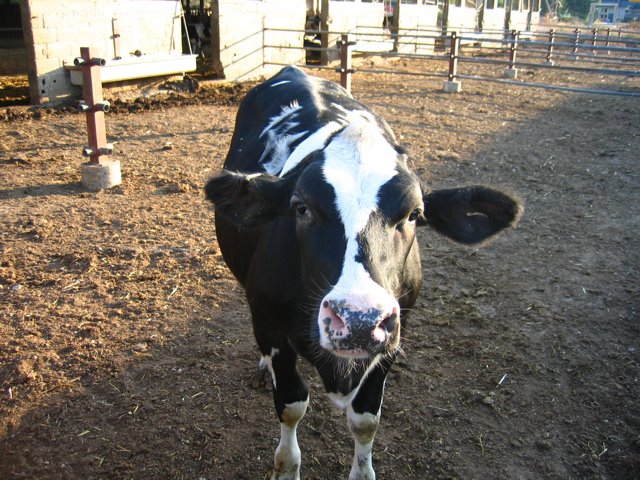
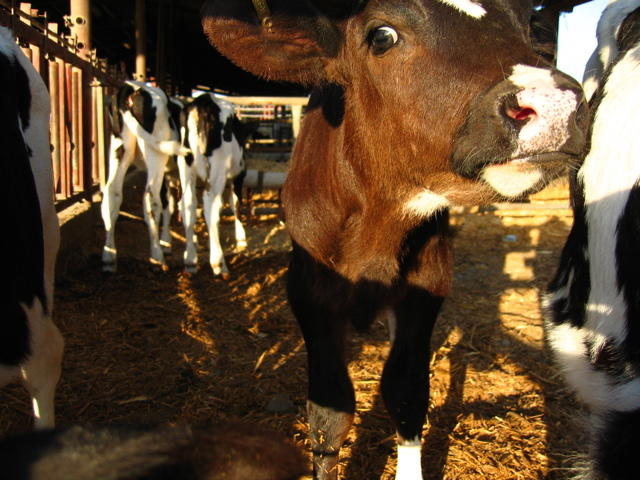
You can see my photos of very young calves if you scroll down this page or click on the "Fish Cow Robot" link at left. Or you can just look at this little character, who's about the size of a large dog:


My uncle, who used to work in his kibbutz's dairy, was candid about how early the calves are separated from their mothers. But the article goes into detail:
    "When a calf is born, the mother is allowed to lick and clean it, but they are separated within 30 minutes to a few hours. Some dairy farmers testify that the separation is difficult on both the mother cows and their calves, based on the distressful cries of both animals. The calves continue to call for their mothers for hours after the separation. These separations are imposed because the calf's presence 'interrupts' the mother's milking routine, and 'wastes' milk. The calves are penned in wire isolation cages, where they are held for about two months."

And so on. I didn't mean to go all PETA here, but the 1300-word article lays bare the downside of an industry that on the one hand shows Israel's agri-ingenuity at its most agri-ingenious (see the article for how the eugenics are handled) and on the other hand has grown out of control.
    "Cows in Israel yield the largest quantity of milk in the world. In New Zealand, for instance, cows produce an average of about 3,450 liters of milk a year; in the European Union, cows give 6,450 liters a year; in the U.S., about 8,200 liters. Conversely, a single cow in Israel produces more than 10,000 liters of milk per year."

And yet,
    "Numerous studies in the U.S. and Europe have consistently shown that the frequency of udder inflammation, lameness and fertility problems increases in direct proportion to the increase of milk production. The genetic enhancement process comes at a cost to the health and well-being of the animal, since the body systems cannot withstand the burden of the intensive activity required by the augmented milk production...."

Note that the situation is not limited to Israel. American cows aren't far behind in their production numbers. It's a cheery piece all right ... and it doesn't even begin to address hormones, antibiotics, or bovine spongiform encephalitis. It's almost enough to make you give up dairy altogether.


*

Sunday, October 23, 2005

My Marshmallow Misadventure

Must admit, it's awfully boring never to have anything new on the blog. OK, here's something fresh and exciting that may make you ill. I wrote it a few days ago but held off posting it to protect the implicated.

I've been back in LA for nine days, having been gone for almost three months. In fact, I haven't even been in LA much yet. I've been avoiding it, hovering on the outskirts where possible. I spent a few days at the Malibu-Ventura county line, where a friend's surfside cottage offered a splendid time-warped antidote to everything I'm resisting about L.A. It wasn't only the porpoises breaching in front of the house every morning, or the pelicans skimming just above the breaking waves, or the lulling white noise of the surf, or the hot tub or the kayak or the lizards or even my pal's boundless hospitality ... no, it was the near-total remove from the Angeleno mindset. I've been easing back in slowly, as if into a very hot bath or a very cold ocean.

So what is it I'm resisting about re-engaging with this city? See Los Angeles Magazine, which exists to glorify most of what I hate about L.A. But that's another post.

In any case, I had a mouthful of answer just this evening. After a longish walk with another old pal, catching up, etc., he invited me to a BBQ. In classic L.A. fashion, we took separate cars to a gorgeous modern house way up in the Brentwood hills above Sunset Blvd. The gleaming poured-concrete showpiece sparkled with modern art, well-groomed friendly people, and an infinity pool. I wanted to lurk in the infinity overflow trough just to jump out and scare folks, but no one was swimming. Who was it slapped Eminem on the stereo -- our genial doctor host in his pricey prefaded t-shirt, or his 12-year-old son? The gym room was being converted to a yoga room, and the license plate on a Mercedes SUV out front read "ZEN CHI." Bobos in paradise indeed. And here's how we entertained ourselves.

The 12-year-old loves s'mores, so papa doc had piled high a big tray with marshmallows, skewers, graham crackers, and an oversized Hershey bar. After dinner, the guests reconvened outside to drape themselves across the furniture surrounding the firebowl. They were chatting in small loud groups until the li'l rascal galvanized all us adults into action with a kooky game straight outta Ancient Rome. And a little child shall mislead them. The diversion called for guests to put as many marshmallows into their mouths as possible while saying the words "Funny Bunny" or "Chunky Bunny" or something like that. None of us boozy adults were able to keep the script straight. I'm sober as a fighter pilot now and I still can't remember the phrase that pays.

As the tray made its way around the circle, the achievement-oriented partygoers kept pushing more sticky fluff into their pieholes and pushing up the number of pushed-in marshmallows, in effect boosting the number to beat. The lone French guy flattened the competition by expertly cramming 14 marshmallows in before calling it quits. Perhaps he had studied how the foie gras geese do it. I sat fireside toasting marshmallows in a decidedly old-fashioned way, occasionally thinking this is just what I can't stand about L.A. -- a repulsive display of excess by bored rich folks in a beautiful setting egged on by a spoiled child. This, I mused, is what I don't want to re-engage with here in Gomorrah. Yes, I am a delightful party guest.

No, really -- I am. Watch: I just sat there making small talk, altruistically toasting marshmallows for whomever and lobbing occasional jokes across the fire. Every few minutes we'd all watch with revulsion as a participant reached his or her regurgitation point and retched forth a softball-sized mass of white goo, like a cocoon from the "Aliens" prop room.

Suddenly, one of the pretty women was holding the tray out to me. How many years had it been since a pretty party guest handed me a tray full of white stuff? When in Ancient Rome, I thought, do as the Ancient Romans do. The firepit had already become a pyre to the remains of our collective dignity, its floor shellacked with burning black regurgitated sugar foam. In a trice, I went from sneering outsider to motivated, if choking competitor, poking puffy sweets deep into each cheek just as I'd seen Monsieur Quatorze do en route to his Grand Prix.

One, two, three ... I paused. "No chewing," someone shouted helpfully. OK, OK. With each new marshmallow, the prepubescent drill sergeant at my elbow barked, "Say it! Say it!" Funny junky! Chunky stumpy! Frumpy flunky! As I stuffed and mumbled easily past seven, eight, even nine marshmallows, La Grande Bouche (aka Bigmouth the Frog) leveled a defensive glare at me. And you know? He had reason to resent. I was out for his record, and I was cramming my mouth full like a meth-addled whore just to beat it. That's right -- I was gunning for his 14. Fifteen, even, just to be the mostest grossest of the gross. As I poked in marshmallow number 10, people started paying attention, even chanting. It was a piñata moment: the screaming is always loudest right before the candy comes out.

And that's when some wiseacre undid me. I heard the words "gag reflex," and mine woke up, as if heeding the call. One more marshmallow, and the pressure on the back of my mouth proved too much. I shoved in the twelfth puff of aerated sugar and gelatin just as the heaves started.

People often say I take things too far. Of course, nobody accused me of that while I was packing in the marshmallows -- how could they? I was just playing along. And after all, gagging is involuntary. Nevertheless, when I retched my own giant white bolus into the dancing firelight -- followed by a few genteel ropes of spittle and dinner and beer -- my fellow guests emitted a chorus of "eeewwws."

It could have been so much worse: It could have been all of the dinner and all of the beer. Why don't people count their blessings?

When I returned from gargling and recomposing myself in the beautifully spare bathroom, another doctor was gracious enough to describe just how widely his own patients' gag reflexes differ. You'd be surprised! We all listened raptly. I didn't notice if the game had ended because of my shocking display or because the tray had gone all the way around the circle and met all its matches. I was just happy noone was calling me "Pukey."

And now, having dishonored my ancestors in the name of fun, I must be back home. Back home in L.A. I'm still trying not to feel like it, but maybe all that "when in Rome" jazz is just my effort to sustain a tourist's sense of wonder, even in the city where I pay my utility bills.

Update: No matter what I wrote that night, it's been more than a week since my marshmallow misadventure, and I feel no more at home here than I did then. (At home he feels like a tourist.) I was talking to a pal in NYC today -- on a cell phone, on the 405, in my convertible, sue me -- about whether the problem is that we're getting old or that our cities are getting worse. I say it’s both. He had to cut short his grousing about noisy bars and overrun Hamptons hotspots, though, because he was dashing off to the sumo wrestling event at Madison Square Garden. Me, I had to change lanes and cut off a pensioner just to shave 30 seconds off my drive.

*

Tuesday, October 18, 2005

Dubious Distinction: 'NYC Discos'

Every few days, Lord Zim likes to check the traffic numbers to this humble site. Visitors come from all over, some twice a day (you know who you are) to look in on this creative ferment. Lately it's been more ferment than creative, but nobody's perfect.

Increasingly, visitors have been looking at two photos I took back in April on a visit to New York. I like these images a lot, but I couldn't figure out why so many people were zeroing in on the long-since-archived pages. Today, however, I figured it out. For some reason, when you type "NYC discos" into the search box on Google Images, those two photos are the first and second results.

This makes little sense. One photo was indeed shot in a NYC disco -- the bonkers Bulgarian disco in Chinatown -- but I'd hardly say it's the quintessential "NYC discos" image. The other, more interesting one isn't even disco-related; it shows a subway tunnel looking "just as magical as I used to imagine one might be before I stopped thinking about them as objects of wonder," as I wrote when first posting. I guess it would be exciting if discos did look like that, though it might be hard to dance around the third rail and syringes and rats.

I'm not sure what this says about Google or Lord Zim or the Italian, Japanese, and South American web surfers who comprise the majority of visitors to these photos. Speculations welcome. And yes, loyal readers: at some impending juncture, I will address the fact that I've left Israel and am back in my prickly hometown.

*

Saturday, October 01, 2005

Field


*

Friday, September 30, 2005

The Dark Side of Donkey Rehab

I'm doing the donkeys and their benefactors a disservice by focusing on the picturesque and anthropomorphic. The story deserves more than funny fuzzy faces.

Earlier this year, the people who run Safe Haven for Donkeys in the Holyland decided to extend a helping hoof beyond the borders of their shelter and to reach out to the donkeys and horses working in the fields and villages. So two months ago, SHADH built a shelter in Tayibeh, a nearby Arab village, and they started showing up every Tuesday with a vet, a farrier, and volunteers. The locals were invited to bring their donkeys and horses for medicine, vitamins, hoof treatment/reshoeing, and harness repair or replacement — all free. Hay and clean water were freely available. The simple but sturdy shelter featured signage in Arabic and English, three bathtubs for drinking water, and a bulletin board with photos of local kids and Koran passages about kindness to animals. Though each week they'd return to find the tubs filled with sand and the decorations torn down, their vet, Pierre, says the problems he treats have become less severe and traumatic.

Last Sunday, someone demolished the shelter with a bulldozer. Evidence points strongly to the local Arab vet, who was offended that he'd been cut out of the deal and had threatened before a crowd of witnesses to destroy the shelter. The razing was so thorough that of all the construction materials, only the tubs are salvageable. The family living across the street from the former shelter site was receiving $100 a week for general cleanup and oversight, but they claim not to have seen the destruction.

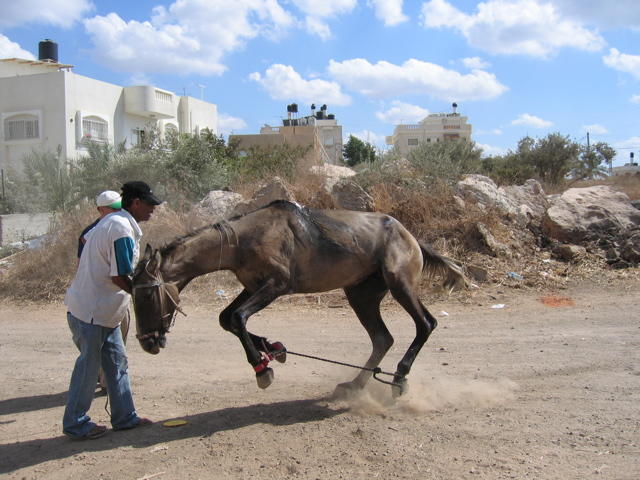
Two days later, the Safe Haven crew showed up again anyway, hay and water and volunteers and French vet in tow, and they treated eight or nine animals -- down from the usual dozen. Instead of gathering under the shelter's shade, they treated the animals in the shade of olive and ficus trees throughout the adjacent lot. Injuries ranged from minor inflammation of the fetlock to a stomach-churning abrasion at the crown of a horse’s back, where a poorly fitted saddle has worn away all the skin and exposed the fat layer.


Note the dark area behind the shoulders and the dark grease stains running down the fur. An injury of this magnitude would land a human in an emergency ward. Yet the owner is still riding and working the horse, which by the way doesn’t have much fat to comprise a layer. Note ribs.


Hobbling the horse to immobilize him for medical treatment. When the revolted vet had finished applying a salve to the area, he handed the rest of the tube to the owner (seen at left in baseball cap), who hefted it and said, "It's empty!"


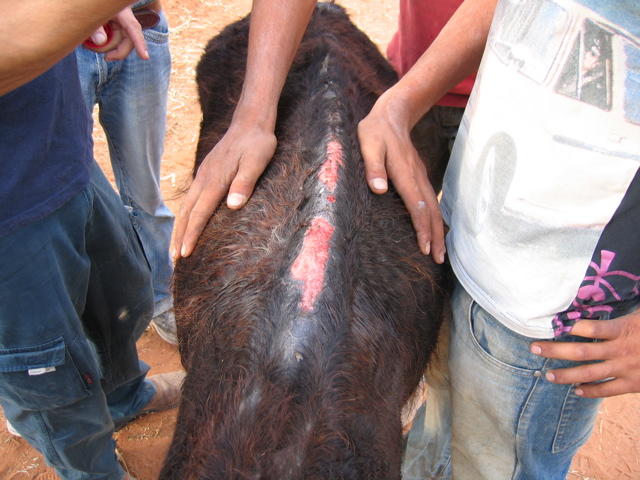
This is not the horse. This donkey, however bloody and brutalized, is in great shape compared to the horse. Most of the donkeys had bloody sores and a general lack of spirits, but only this one showed an entire spine rubbed raw by, again, ill-fitting gear.

At the very least, they all spent some time in the shade eating hay and not working. It's a far cry from the bucolic playground at SHADH, but it's something.

So now the story of the Tayibeh outreach is no longer a simple heart-warming tale of crazy foreigners obsessed with animals. There’s intrigue and police reports, good guys and bad guys, and an animal-loving local who’s offered his side-yard to replace the demolition site.

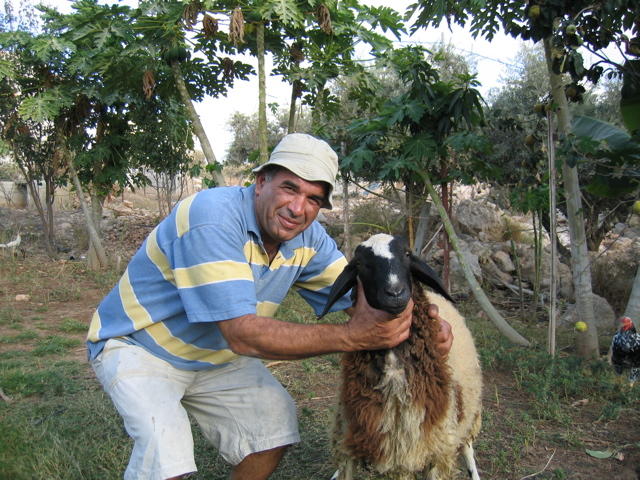
Muhammad, a kindly man with a face very like a sheep's, wears a typically Israeli "tembel" hat. He raises rabbits and doves in adjacent hutches, half a dozen sheep, numberless exotic chickens, and a small flock of black turkeys in an enormous yard shaded by tropical fruit trees. He raises the sheep for fun, he says, but then slaughters them: "What else would I do?" He says he never eats anything he's grown himself. In a shady corner of the yard where chickens and sheep gambol all the live long day, he keeps a small nervous dog in a cage that would be confining for a rabbit, because "he makes trouble." The skinny little thing, all of six months old, was happy to lean against my hand and feel a pulse. Muhammad says he lets the dog out at night.


Muhammad and his prized doomed sheep.

Earlier, Muhammad's neighbor had promenaded over to the Shadh site to show off his very personable exotic goat. It was distinguished by a complicated udder and a nose that might be called comically aquiline. He was so proud of her, it pained him to see me photographing her attached to a common rope. Someone had made off with her more attractive leash, so he finally set his quarter-Syrian beauty free to ensure the photos presented her with becoming dignity. She was very attached to him and didn't wander far.


I offered to email him some images, but getting the email address was incredibly difficult. For starters, only Muhammad has email, which is okay because they're neighbors. But then Muhammad handed me the phone to speak with his daughter, who kept saying "M" -- or was it "N"? The simple "M as in Mary or N as in Nancy" routine we do in English-speaking countries only complicated matters. Maybe because I kept saying "N as in Natz-ret [Nazareth] or M as in Muhammad?" It took five minutes to get the email. Mercifully, it's a Hotmail address. I don't know if I could have handled any more challenges on the right side of the "streudel." (Streudel: a rolled-up pastry (@).)

There is no simple resolution to the Tayibeh situation, or to the problem of animal cruelty, especially in a poor society, or beyond that, to the problem of Arabs and Jews working (or not) together. SHADH's Tayibeh outreach might seem like a model for cooperation, but deepset distrust, entitlement, and cultural differences undermine progress. Given free vet care, the locals want a landscaped park like the one Coca-Cola recently built. Meanwhile, SHADH employs two Arabs and a Thai worker, and they're soldiering on to improve life for the animals ... whether the bipeds help or not.

*

Behold the Heroic Donkey

Okay, I confess. I've been spending time with the donkeys at Safe Haven for Donkeys in the Holyland again. People here think I've lost my mind. Maybe you do too. Maybe I have. If loving donkeys is wrong, I don't want to be right.

Donkeys are a lot like big dogs. They love attention. Predictably, some donkeys also love the camera. And the camera, as they say, loves them. Like this one. Note how he goes from forlorn ...


... to supercilious with total ease. Eye makeup like that makes anything possible.


Note how I shamelessly anthropomorphize. Hang onto your saddle horn; it's about to get worse.

Eventually, this donkey became very interested in the camera itself, probably because of the flash. When I finally stopped taking pictures and petting him and stepped over the fence to leave, he kept an eye on me. I tried to come back a few minutes later, but he trotted a few feet away again.


I tried to approach again, and he moved away once again. Then I walked right at him and he galloped off down the field, gimp leg and all.


It really makes me wonder about the donkey sensibility. Sounds crazy, I know, but he seemed genuinely offended that after our photo session I was just, well, done with him. I guess I should expect his invoice and maybe a recriminating note in the mail. If you're reading this, baby, you're beautiful. Don't ever change.


*

How to Update an Ancient Language

Flogging that parve hemi-semi-demi-notoriety (see previous post), I have yet to tell my aunt about it, though it was she who originally used the word in our interview. Given her unrelenting attention to Hebrew etymology, particularly in reference to those English-language words forever being sucked into this evolving new/old language's maw, I think she'll be tickled by her contribution to reversing the current. I say unrelenting, because having invested a few hours in my language education, she now happily interrupts conversations to point out examples of the two main rules she's taught me.

And they go like this. Modern words (i.e., those not found in the Bible or related works), are generally created or adapted for Hebrew use in one of two ways.

1. The word may be derived by stretching an existing word/word family; e.g., from lakhshov (to think) we get makhshev (computer). Note that the same root may have long ago been extended to a related meaning, such as khashoov (important, or worth thinking about).

2. The word may be adapted by recasting an English word; e.g., nah-vee-gaht-see-ya (navigation) or psee-kho-lo-gee-ya (psychology) or (and this one throws people) ee-air-ar-shee-ya (hierarchy). I heard a neck-snapper today: teh-rah-poi-tee-ka (note the German pronunciation of the "eu" in therapeutic).

In many cases, a word derived from a Hebrew root exists but people just ignore it and use the adaptation. One of my favorite indigenous words for a modern concept is mootag, which means brand, as in consumer brand. My aunt thinks it comes from meteg, the word for electric switch, but she's not sure. I guess I could look up that meelah in a meelon or dictionary, which is itself a fairly recent invention with an easily derived name.

*

Tuesday, September 27, 2005

Word of the Day: Parve

I discovered a very interesting website today, because it discovered me first. Owing to my aunt Bilha's colorful choice of words, my recent Gaza disengagement story and I have been inducted to Double-Tongued Word Wrester, a site by and for people who like words.

May I present the term "parve".

And I'll amplify the definition cited with the following insight to modern Israeli usage: When it's not referring to a type of food, "parve" typically describes a spineless person. One might note that my aunt's usage included that definition, though you could argue the point. With her.

*

Sunday, September 25, 2005

Uber Roach

The cell phone antenna just quivered near my leg here on the bed and I nearly jumped off. Why so jittery, you ask? Only the biggest fastest cockroach in Israel, that's why. While most of you were busy watching a game or ordering grande decaf mocha lattes, yours truly was engaged in a high-speed battle of midnight wits with the largest, lowest, swiftest arthropod ever. Fucking roach was flying across the carpet -- but that was only after we faced off in the tiled bathroom. I had a vague notion he might fling himself down the drain if urged in that direction, but no, this hexa-legged individual wanted the territories, the wide open spaces. So when I made the mistake of getting between him and the door, he charged.

OK. I've lived in New York. I've seen the littlest Gothamites scuttling across sidewalks with impunity. I've watched with amazement as herds of roaches swarmed darkly across the kitchen walls of an apartment once occupied by He Who Shall Remain Nameless. My point is that I have seen big bugs before. But even those tough Harlem roaches knew better than to charge me. Is it the climate? Something in the fertilizer? The natural bellicosity of Middle Easterners? Maybe he could see I was barefoot and squeamish. The screaming and wild dancing probably tipped him off.

Oh, so you think I'm a sissy, tough guy? He raced directly at me, antennae waving, six barbed legs flailing away, hitting land speeds unimaginable by the North American Domestic Roach. And that's the problem. This was a big outdoor bug bringing his desert survival skills to bear on an urban biped. I truly thought he was going to run up my leg and into my mouth. Or something. That's how determined he looked.

The funny thing is that I was on the phone with my dad at the time, while I was overreacting. As readers of the AZ Lexico must know, aSWQ2 --

Jesus Christ! Flying beetle just landed on my leg. A smaller beetle. Do I need to set up smudgepots and flypaper? Why there aren't screens on all the windows here I'll never know. I'm expecting a millipede procession to come through here with a brass band and firecrackers any minute now. For the record: I usually don't mind a few bugs in the house. I welcome spiders. And I reside here at the pleasure of several tiny translucent lizards. They're skittish but charming, and they typically stick to the upper reaches of the walls. I guess I'd be skittish too if I had to look these Cadillac-sized cockroaches in the eye on a regular basis. But reptile or insect -- too much of even a good thing is still too much.

(aSWQ2 is not code or geekspeak -- it's what happens when I leap off the bed and fling away the laptop.)

As I was saying, as readers of the AZ Lexico must surmise, my dad is not given to literary references, but after I got done yelling about the first bug, he immediately started talking about "Metamorphosis" and how it scared the hell out of him 40 years ago. "Changed my life," he said. "I haven't killed a cockroach since. He's my brother!"

So that's how the bug got in. He has his own key. Silly me. Next time I'll put out a platter of rotting flesh and some magazines. Meanwhile, the smaller flying roach keeps landing on the bed and trying to appear inconspicuous. Maybe I should go sleep in the fridge. Maybe I should get over my aversion to killing. Maybe this is where suicide bombers go instead of heaven and 72 virgins: They have to buzz bug-shy insomniacs until swatted into the next hereafter.

A third and new kind of flying roach just landed on the bed and got tangled up in the topsheet before I flapped it free. It then did a high-speed perp-walk across my bed and over the edge. I've figured out why this is happening. I'm turning off the overhead light.

And now for the thrilling conclusion of our tempest in a teapot: I watched the Big Bug scuttle into the tiled living room at 45mph and hoped that would be the last we see of each other. But now he's probably done hoovering up crumbs from the kitchen floor, has doubled in size, and is ready to rumble. I'm going to set up a police blockade and apply supertoxic bug repellent like Bathsheba slathered goo all over the King of Siam. Or whoever. Enjoy your latte. My entourage and I are going to sleep.

*

Monday, September 19, 2005

Tuesday, September 13, 2005

Fish Cow Robot: Nature Contained

My little contretemps with water (see previous post) has only led to more swimming. Swam in a spectacular indoor pool two nights ago, and yesterday I visited a spring-fed pond set amid grassy banks, volcanic rock, and mature trees. It’s actually three pools, the first two separated by a waterfall and the second and third by a defunct flour mill. Though I’ve visited Gan HaShelosha (Garden of the Three) dozens of times, it's been years since I ventured past the first pond, which is about as long as an Olympic pool but holds a lot more fish. I swam the length of the first pool and decided to venture ... beyond.

The second starts with a wall of water: hundreds of gallons a second tumbling 15 feet off the lip of a 30-foot wide concrete shelf. I stepped in a few feet from the torrent and swam into it completely submerged. Late afternoon sunlight slanted into the water suffusing it a bright creamsicle blue. Under the cascade billions of exploding bubbles bobbled itty-bitty to the surface and there, barely beyond the effervescence, hovered thousands of tiny fish. Watching me. Treading water. Doing fish things. Like nibbling at my feet. I hovered there beneath the surface, goggling at the wildlife and resurfacing sparingly, until my lungs couldn't take any more, and then I swam the length of that pool. It's strange to swim among fish, to watch them dart away from your hands as you cut through the water.

Dairy King Live

An hour later, at Kibbutz Sheluhot, a religious farming collective, I communed with young dairy cows, who are so hungry they'll suck on anything, including hands ...


thanks to early separation from their working moms.


As one calf slimed my hand most grievously, I felt his rough tongue and new molars. Very strange. A lot of suction. The younger calves were very friendly, kind of like big dogs (which is what cloistered urbanites always say).


The next age group up had already learned fear -- probably when the numbers were seared onto their backs -- but curiosity eventually overcame apprehension, and some realized they liked having their knobby heads scratched.


What I learned about calves from my uncle Jack, who used to work in the dairy: From three days on, the calves have unlimited access to grain and hay but only see their moms three times a day -- after the automatic milking machines have extracted 30-40 liters of milk (each day). Within a short time they stop getting real milk and are put on formula. Other dairy trivia: barcodes on the cows' hooves help track their productivity and even consumption.


Israel has one "Robotic Cowshed," which allows cows to disgorge their udders at will. Robot-milked cows generally come in for milking five times a day, which makes them more productive and theoretically more content than cows that have to wait for humans to milk them just three times a day. Robotic cowsheds are popular in Europe.

Temp Solution

The labor situation at kibbutzim has changed radically in the past 10 years, thanks in large part to the Intifadeh, which both scared off the traditionally European and American "summer in Israel" volunteers and led to the rejection of Arab workers, who were deemed an unsafe risk. Now East Asia provides cheap, reliable labor to keep the kibbutzim and old folks' homes and restaurants humming. At Sheluhot, where my aunt and uncle have lived their entire adult lives, a group of Thai men live wholly apart from their employers in a U-shaped cluster of trailers. Imported farm hands. Their presence is symptomatic of the sickness of the kibbutz system, once a powerful and exemplary component of Israel's labor-driven society, now a splintering relic riven by diverse new economic and societal pressures in a country where high-tech has replaced agriculture as the key to a better tomorrow.

Kibbutzim hold little interest for ambitious youth, and so the average age of the kibbutz-dwellers is rising. Theoretically, and this is a wild excursion, in a near future some kibbutzim could be operated by old men and women pushing buttons and barking orders to crews of Asian workers. This is the secular humanist in me going off, but I think the complete segregation of foreign workers from the community's social fabric compounds the sickness of the kibbutz system. I also think turning cows into machines is another form of sickness, but this denaturing is far worse in the U.S., where Mad Cow Disease is nature's revenge.

But the Thai workers probably don't know they're symptomatic of anything beyond globalization, if that. Meanwhile, their employers are very happy with them; my uncle said they're like "robots" -- they really get the job done. I stumbled upon them while photographing a sun-splashed tower of palletts near their trailers.


When I tried to approach, they waved me away. I thought to regale them with tales of Hollywood Blvd.'s Thai ex-pats -- well, no, but I was willing to play any card I had for a plate of whatever they had for dinner. But they professed to speak neither English nor Hebrew and just kept waving and smiling and shaking their heads. Sent me surfing out of there on a wave of liberal guilt and frustration. Walking away, I was amazed to see a small but lush patch of Thai greenery, bright with small spiky peppers, spherical striped eggplants, lemongrass, basil, mint, and other herbs, all under the care of a sophisticated combination of drip and spray irrigation (a technology Israel pioneered).


This is where the Thai workers talk to their loved ones back home.


That you can swim with fish in a natural pool just 10 minutes from a place where people and animals have been turned into robots is part of what makes Israel so strange and contradictory. That, and
Arab vs. Jew,
Ashkenazi vs. Sephardi,
Labor vs. Likud,
far left vs. center left
far right vs. center right,
religious vs. secular,
religious vs. ultra-religious,
city vs. country,
North vs. South,
old vs. new,
rich vs. poor,
new rich vs. old rich,
new immigrant vs. old immigrant,
etc.
etc.
etc.

*

Monday, September 12, 2005

Swimming Lesson After Dark

After a week of lying in bed sick or recovering on unsteady feet, I slipped back into my running shoes for the first time in seven days and headed out to meet the setting sun on the sand. The run itself was uneventful. I invented a few crises just to keep my speed up -- won’t let those guys catch up! There's someone chasing me! -- but it was basically the usual plodding slog up to the Arab fishing village and back down to the southernmost rocks and then back again to the lifeguard station. What's new is that, now that I know sea turtles choke and die on plastic bags they mistake for jellyfish, every unnatural glimmer in the sand is an interruption. I stop, stoop, scoop, and soon enough have a handful of wet sandy sacks, which I have to carry the length of the beach to a trash bag at one end or the other. It's a pain and the odds are unlikely, but what if I save one turtle's life? I skip plastic cups and bottles, because turtles probably can't swallow those, and I'm hoping that plasti-foil popsicle and chips wrappers look too unnatural to be tempting.

So I had my 45-minute run, and when it was done the sun was long gone. A few lights twinkled on the beach and at the power station, but the water and beach were dark. I left my shoes, socks, and glasses by the unmanned lifeguard tower, and sallied into the drink. A week ago, as I'd walked into the water at much the same time, unnaturally morbid thoughts had swarmed heavily around me, provoking a sense of finality, of solitude, of my last walk into an ocean ever. It was like living my own Joy Division song. But the swim had gone well, and I'd emerged more because of boredom than anything else. That was a week ago.

Tonight, the dark thoughts hovered again as I walked into black water under a deep purple sky, but I brushed them aside. The waves were stronger than usual, even aggressive. One slammed into my crotch, which didn't hurt, but hey, fella -- what's the big idea? I hadn't ever swum here at so high a tide, and because of the sand's steep angle, high tide seems to strengthen the waves more than it does at the shallow-approach Santa Monica beaches where I grew up.

Another difference: The water is so warm here that diving in requires no fortitude at all. I used to resent the tub-like easiness, but now I'm used to it. You just dunk in like a dolphin, no jaw-clenching required, and start frolicking or swimming. Which I did. I swam submerged for a half-minute or so and felt three waves suck me sharply upward as they passed. Then I surfaced, did a lazy breast stroke out to sea for a few minutes, and finally stopped to see where I'd ended up.

Far away. The silhouetted lifeguard station was much smaller than I wanted it to be. Imprudent to remain so far from shore, I thought. Time for a real breast stroke back, just to stay within a comfortable distance, and set to work at a moderate pace. I expected to close the gap with ease. But when I paused again to check my progress, there seemed to be none. I tried to gauge my relationship to the illuminated power station chimneys on my right versus the half moon just above them, but wouldn't you know it -- I'd left the sextant on shore with my tennies. So I started swimming again, with more conviction this time, and after a minute or so paused again to see how far I'd gone. Still no visible progress. I mulled the possibility of panicking. Talked myself out of it and went back to swimming. Stories about recent drownings at this very beach swam up to greet me in the turbid waters, and I put more muscle into my stroke. Kept it up for two or three minutes, all the while wondering how exactly one drowns: Does water suddenly flood into your nose when a wave hits just as you're inhaling, thus provoking a coughing fit that floods the lungs? Does fatigue take you down after the tide has taken you out? How mediocre a swimmer do you have to be to lose it in a non-stormy ocean? How mediocre a swimmer am I? What about sharks? Motivational thoughts like these kept me stroking away as a series of big, loud waves crested around me. When I finally dared to stop again, my feet still didn't touch bottom. OK to panic now? I mean, WTF? This doesn't happen to me. I'm a good swimmer ... aren't I?

Started swimming again. I didn't want to put all my strength into it, just in case the tide was so strong that it was truly pulling me out and would force me to maintain strength-conserving survival strokes for hours. So, panic rising, I swam at an easy pace for three or four minutes straight and then looked up to see, finally, the station looming a comfortable distance away. Panic subsiding, I swam to where I could touch the bottom, swam a little further, and then walked right out of the water. Not shaking. On my way out, a freakishly strong little wave, like a midget wrestler, slammed into my back in a jovial, obnoxious way. Same to you. I was glad to be out. It’s been a long time since I felt anything like real fear in the water.

I was nine or ten the last time I felt true terror at the beach. Though I spent every weekend of my childhood at Santa Monica beaches, one afternoon a wave or three swept me out farther than I was used to going. I started flailing and yelling and thinking I was dying, and just as my young life seemed to be drawing to a watery close, someone materialized to hoist me up and restore my footing. The lifeguard forbade me to go in deeper than my waist for the rest of the day. I disobeyed, of course.

Acting as my own lifeguard tonight, I went straight home.

*

Thursday, September 08, 2005

Lights, Camera, Roadside Attraction

A content-free post, featuring nothing but eye candy shot while driving home on the mighty, privately financed toll Highway 6. Images are bigger than usual and may be slower to load. No post-exposure enhancements or alterations.


1.


2.


3.


4.


5.

Name Game

1. Crouching Insect, Hidden Rorschach
2. Nahshonim Interchange 1500
3. Bit Torrent
4. Square Egg
5. Local Dialect

*

Tuesday, September 06, 2005

Rah Rah, Sis Boom Bah Humbug!

In this time of catastrophe, when even w. cuts short a vacation, his mom, she of the tasteful pearls and imposing George Washington looks, had the minor misfortune to be interviewed on the unfortunates of New Orleans:

"So many of the people in the arena here, you know, were underprivileged anyway, so this -- this is working very well for them."
    
You can hear her here.   

At some point, they decided not to let Reagan out in public any more.

*

Thursday, September 01, 2005

Donkeys!


Tippy here rules the barnyard. And she knows how to hold a pose.


Tippy and friends vying for carrots.


Just like giant rabbits. They'd much rather be hand-fed than have to scrounge the sandy floor for carrots, though they have plenty of hay at all times.


A framing device. And it gets excellent TV reception. Who knew donkeys were so photogenic?

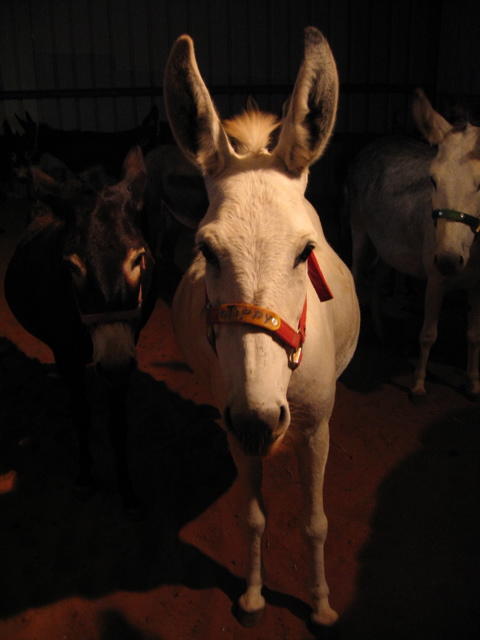
I spent Tuesday afternoon with donkeys and the Mother Teresa of Donkeys, Lucy Fensom. She founded Safe Haven for Donkeys in the Holy Land in response to the widespread abuse and neglect visited upon these solid little citizens whose primary offense lies in costing so little that they have no perceived value. One of Lucy's goals is to change attitudes and behaviors. She also wants to save every donkey she can from beatings, burnings, mutilations, and death perpetrated by angry mobs, bored kids, and other stupid cruel people.

As someone said to me last week, "Donkeys aren't stubborn ... they're just patient." And they lack options.


Donkey got soul.


Donkey got back.

With 85 well-cared-for donkeys at the farm and an impish toddler underfoot, Lucy and husband Adi nevertheless steal away for three to four hours every Tuesday to run a donkey and horse outreach clinic deep in a small Arab village. The vet, farrier, and volunteers provide basic medical care ...


hoof trimming ...


and harness adjustments for donkeys and for horses, which may cost a lot more but still get a hell of a lot of abuse. As one horse owner told me while accepting free hoof care and reshoeing, a donkey can pull 200 lbs. but a horse can pull 600 lbs. Both numbers are too high, which helps explain why his horse was such a wreck.


All the working animals we saw had sores and open wounds from poorly fitted, borderline medieval harnesses.


The antiseptic spray isn't designed to blend in.


This little donkey came in with a big iron cart and an ancient Arab driver.


Thanks to an ill-fitting strap, he had a big open wound behind his right foreleg. A volunteer tried to pad it with moleskin, but it didn't look good. As grievous as the donkey's condition was, the old guy who owns him has very few teeth left and probably not many years on tap either, so it was (a little) tough to fault him for his donkey's woes. Life is hard here. All things considered, he probably treats his donkey as well as he can, because it's his livelihood. That's what I'd like to believe, sores notwithstanding.

On the other hand, another guy showed up for the second week in a row demanding Lucy take in his weak, old, sick donkey and replace it with one of her healthy ones. No reason. That's just what he wants. He refused to pose for a picture, but hung around smoking and chatting for hours as his donkey stood in the sun waiting. Lucy gave it water, shots, and superficial first aid, but she won't serve as a donkey exchange, taking in the sick and giving away the healthy. Once a donkey's gone to heaven, she won't send it back to hell.

This is the freeloader's sad, weak donkey, below ...


waiting patiently in full harness with a big iron cart secured to its back. That's a little boy from around the way who came up and petted the donkey's nose for a moment and then smacked it for no apparent reason. He received a stern talking to, with instructions on proper donkey interaction. In addition to ministering to donkey wounds, the clinic seeks to educate current and future donkey masters. There are a lot of ingrained bad behaviors and attitudes to undo.


This is the wounded donkey seen above, unharnessed. Left no better options, donkeys will eat ficus leaves. And look picturesque.

SHADH survives on donations from abroad, mostly the UK and US. At the site, you can read more, meet Lucy and the donkeys, and even "adopt" individual creatures such as Tippy, Chico, Primrose, Shrek, and Jake.

You! Who Are You?

Who's reading this blog in Vermont, Arizona, DC, OK City, and Santa Rosa? Happy to have you here, but how did you find Lord Zim, and have we met? Special prize for the first two people to respond.

This violation of the fourth wall is probably a massive faux pas in blogiquette, but what are you gonna do about it? You can't disturb me any more than the giant winged beetles already do.

BTW, vanilla soy milk + Fernet Branca = White Russian with a mothball twist.

*

Last One Out Update the Website

When K and I visited New Orleans a couple years ago for NYE, we had a tremendous dinner at NOLA, a restaurant so good it didn't matter that TV chef Emeril owned it. In a very vain attempt to personalize the disaster, I looked at NOLA's website just now and saw this sadly glib scrap of verbiage:

"With a hurricane swirl..........the strength of the storm by which Emeril Lagasse has taken New Orleans......... with a whirlwind of fresh adaptations of classic Creole cuisine."

Oops. Ouch.

Speaking of oops and ouch, my uncle here in Israel, who is responsible for getting Gaza settlers relocated into new homes throughout this tiny, poor country, is shocked by the way America left so many poor people behind just to suffer and die in a decrepit stadium. I explained that America's ruling powers don’t care about poor people. Some lives are cheap.

Two scenes from "Fahrenheit 911" come to mind: w sitting dazed and ineffectual with a children's book upside down in his lap upon hearing about jets hitting the towers, and when he tells a roomful of wealthy donors, "Some people call you the elites; I call you my base." Much better to have our poverty-drafted National Guard defending Chevron’s interests in the Gulf than at home doing what they signed up to do: preserve domestic peace in times of extremity.

OK, plenty of bloggers are doing similar rants with greater erudition and effect than I. New Orleans was a sitting duck and now, in his impervious, oblivious way, so is w.

*